The Science Behind AirTulip

Cleaner Air Starts Where You Breathe.

A filter captures particles. Airflow determines where the filtered air goes. AirTulip brings those two ideas together at the head of your bed.

See How It Works
Green laser light reveals airflow above a person reclining against an AirTulip headboard
AirTulip airflow demonstration, made visible with laser light and airborne particles.

The Last Few Inches Matter.

The breathing zone is the air immediately around your nose and mouth. It is the point where room air becomes the air you inhale.

AirTulip Sleep is designed to deliver filtered air directly toward this area. The headboard combines filtration with a broad, directed outlet, rather than relying only on air mixing throughout the bedroom.

  1. Filter The Air

    Room air passes through the headboard's particle filters before it reaches the outlet.

  2. Shape The Flow

    Internal channels guide the filtered air into an organized stream. This controlled delivery is the principle behind AirTulip's laminar airflow design.

  3. Deliver At The Pillow

    The outlet sits at the head of the bed, close to the sleeper's breathing zone. Placement and airflow work together.

Two pleated AirTulip Sleep particle filters

Filtration Is Only Part Of The Design.

The pleats give the filter a large surface area in a compact space. AirTulip's engineering also considers the fan, internal air channels and the shape of the outlet.

Filter efficiency describes what happens as air passes through a filter. It does not, by itself, describe the concentration of particles at your pillow. That depends on the complete system and the conditions around it.

Make The Air Visible. Then Measure It.

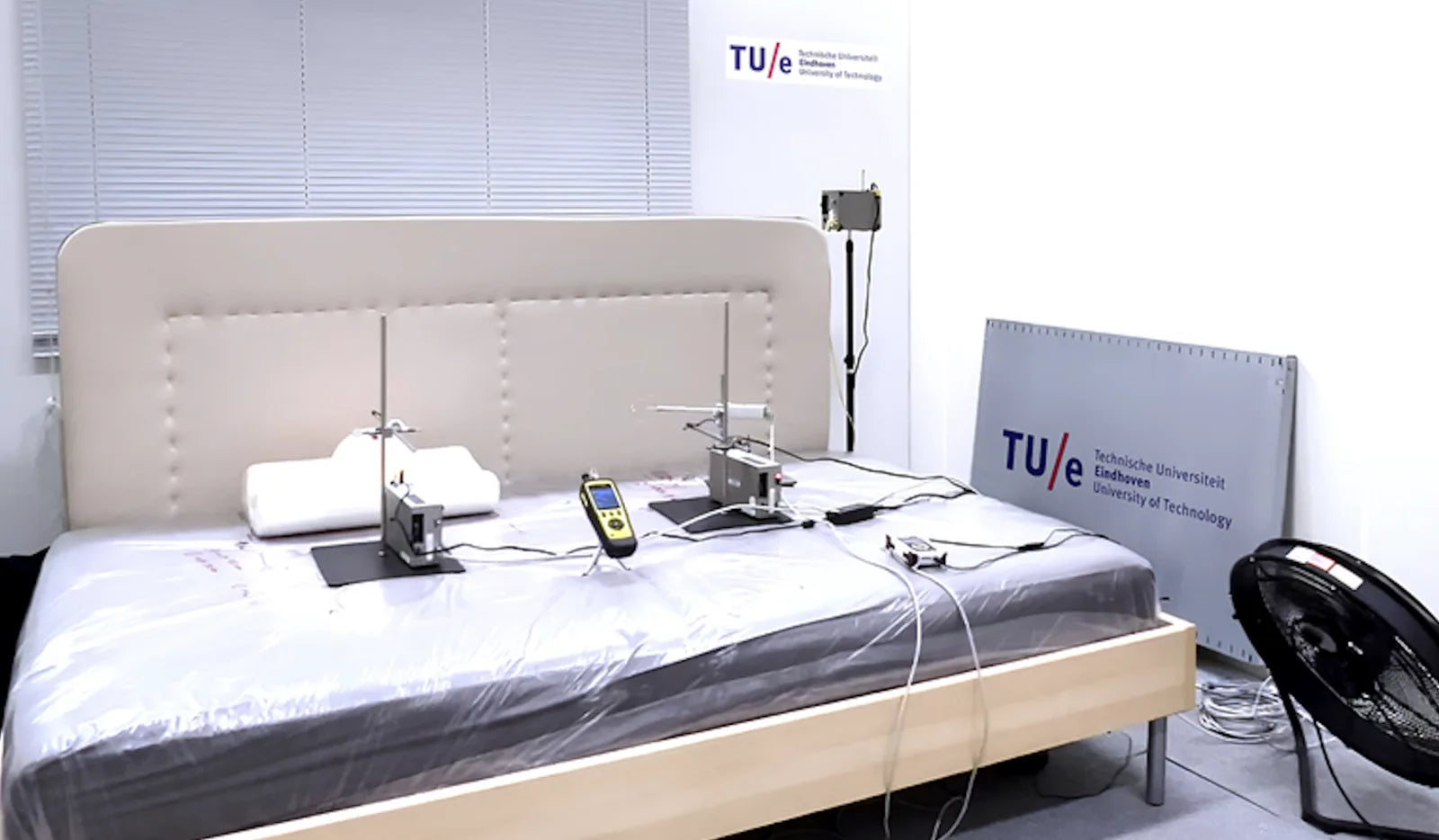
Airflow is invisible in everyday use. Visualization and instruments let engineers examine how it travels and where to take measurements.

AirTulip headboard with instruments and sensors in an Eindhoven University of Technology laboratory
AirTulip laboratory setup at Eindhoven University of Technology, from the AirTulip engineering archive.

Visualize The Flow

Laser light makes suspended particles visible, revealing the movement of air. The demonstration shows flow behavior; it is not a numerical filtration test.

Measure At The Breathing Zone

A measurement beside the sleeper answers a different question from a room average. Sensor location and test conditions matter when interpreting a result.

Evaluate The Complete System

Air delivery, filtration and acoustic design must work together in a headboard intended for overnight use. The engineering process includes prototypes, test rigs and airflow modeling.

Eindhoven University Of Technology | 2024

Why Air Delivery Deserves Its Own Research.

Read The University Thesis

Research into personalized ventilation asks a precise question: can delivering air close to a person change the air they inhale?

Appendix H of Hailin Zheng's doctoral thesis describes preliminary climate-chamber experiments using an AirTulip-supplied ventilation interface. Researchers varied the direction and rate of air supply around a breathing and thermal model in a semi-enclosed baby bed. Head-side delivery produced the lowest inhaled COβ‚‚ concentration among the tested directions at 55 mΒ³/h.1

1. Zheng, H. (2024). Indoor Air Quality in Daycare Centers. Eindhoven University of Technology. Appendix H, pp. 307–314.

Illustration of an unoccupied bedroom overlooking a city at dusk

Research from Cambridge, Tsinghua & Sleep Cycle

The Link Between Air Pollution And Nighttime Coughing.

A study spanning 32 cities linked higher levels of outdoor fine-particle pollution with more frequent coughing at night.1

2.4%

More nighttime coughing

Associated with each 10 Β΅g/mΒ³ increase in outdoor PMβ‚‚.β‚… concentration.1

32 cities across 12 countries. Approximately 500 days of observations.

How The Study Worked

Researchers combined city-level air measurements with anonymized cough counts from Sleep Cycle, then tested whether daily changes were related.1

  1. Measure Outdoor Air

    Monitoring stations supplied daily concentrations of PMβ‚‚.β‚… for each city.

  2. Count Nighttime Coughs

    The app detected coughing during sleep recordings. Researchers calculated coughs per recorded hour and grouped the data by city and day.

  3. Compare The Patterns

    Statistical models accounted for weather and influenza activity. City-level results were combined to estimate the overall association.

Small Particles. A Measurable Association.

PMβ‚‚.β‚… refers to fine airborne particles no more than 2.5 micrometres in diameter. The study examined outdoor concentrations, rather than measuring the air beside each participant’s bed.1

The Link Extended To Lower Pollution Levels.

The researchers also detected associations below the WHO’s 24-hour PMβ‚‚.β‚… guideline. The findings suggest nighttime coughing can respond to changes in air pollution even at relatively low concentrations.1

From The Laboratory To The Bedroom.

The practical idea is simple: bring filtered air close to a person who stays in one place. The bedroom gives that idea a clear purpose.

At The Head Of Your Bed

AirTulip Sleep incorporates the airflow system into the headboard. It puts the outlet near the pillow without adding a separate tower beside the bed.

Explore AirTulip Sleep

Part Of A Cleaner-Air Routine

Keep the air path unobstructed and maintain the filters as directed. Filtration works alongside source control and appropriate ventilation; it does not replace either.

Earlier AirTulip Applications

An earlier AirTulip tower installed in a shared office lounge

Shared Workspaces

An AirTulip tower in an office lounge. Earlier installations explored air delivery around people seated in a shared space.

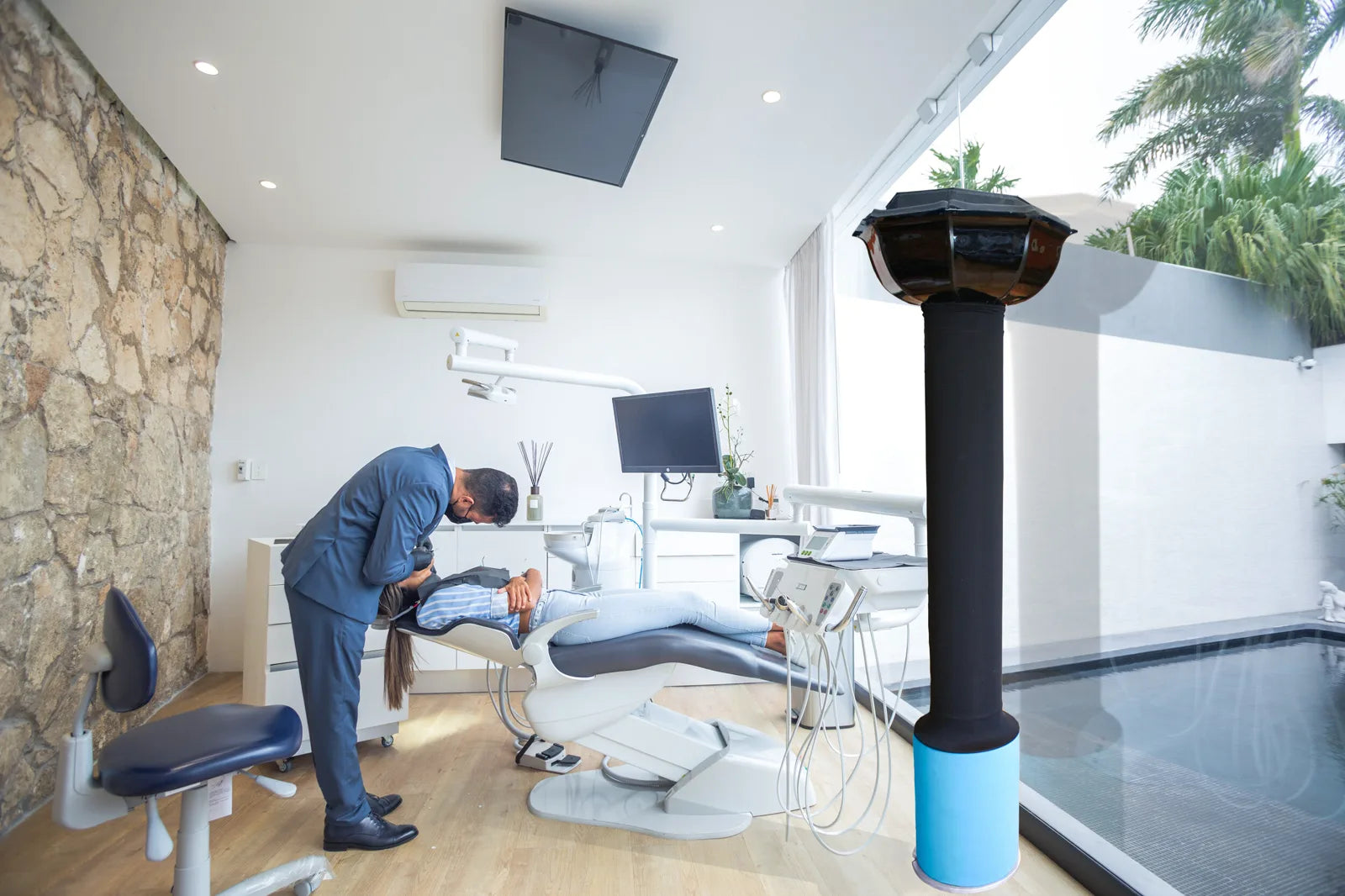
An earlier AirTulip tower beside a dental treatment chair

Treatment Rooms

An AirTulip tower beside a dental chair, showing another setting where a person remains in a defined position.

Installation photographs from AirTulip's archive show earlier systems, not the current Sleep headboard. They document applications, not clinical outcomes or infection-prevention effectiveness.

A Closer Look At The Evidence.

The distinction between a mechanism, a laboratory result and a health outcome matters.

Did The Cambridge Study Test AirTulip?

No. It examined the association between outdoor fine-particle pollution and nighttime coughing recorded by a sleep app. It did not test an air purifier or establish a sleep benefit from AirTulip.

Does A Laser Demonstration Prove Particle Removal?

It makes airflow and suspended particles visible. A quantified removal claim also needs particle measurements, a documented protocol and clearly stated operating conditions.

Is This A Substitute For Ventilation?

No. Particle filtration and ventilation do different jobs. Ventilation exchanges indoor and outdoor air; a recirculating particle filter does not remove the COβ‚‚ people exhale.

Does The University Research Prove Better Sleep?

No. The cited thesis experiment measured ventilation around a breathing model. It did not measure sleep quality or clinical health outcomes in people using AirTulip Sleep.

See The Engineering In Your Bedroom.

Explore the headboard, its design and the details of everyday use.

Explore AirTulip Sleep